Development of a Microscope Capable of Observing Electron Behavior with 1-Micrometer Resolution ~Expected to Accelerate Research on Quantum Materials and Next-Generation Information Processing Devices~
A research group including Researcher Kohei Yamamoto and Senior Principal Researcher Jun Miyawaki of the National Institutes for Quantum Science and Technology (QST), and Assistant Professor Hiroto Suzuki of the Frontier Research Institute for Interdisciplinary Sciences, Tohoku University, has successfully developed a microscope capable of visualizing the behavior of electrons in materials with a spatial resolution of one micrometer or less.
This achievement was realized using QST’s resonant inelastic X-ray scattering (RIXS) instrument “2D-RIXS”, which has ultra-high energy resolution capable of distinguishing extremely small differences in electronic energy states. The instrument is installed at NanoTerasu.
This is the first time in the world that electron behavior inside materials has been visualized with micrometer-scale spatial resolution using a RIXS instrument. The new technique is expected to accelerate research on quantum materials and the development of next-generation information processing devices.
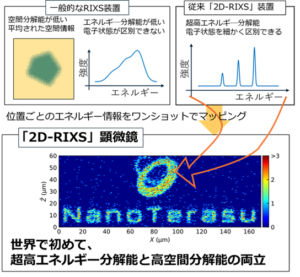
(Press Release: March 11)
https://www.qst.go.jp/site/press/20260311.html
Tohoku University and Fujitsu Use AI to Discover Promising New Superconducting Material
On December 23, 2025, Tohoku University and Fujitsu Limited announced their successful application of AI to derive new insights into the superconductivity mechanism of a new superconducting material. Their findings demonstrate an important use case for AI technology in new materials development and suggests that the technology has the potential to accelerate research and development. This could drive innovation in various industries such as environment and energy, drug discovery and healthcare, and electronic devices.
The AI technology was utilized to automatically clarify causal relationships from measurement data obtained at NanoTerasu Synchrotron Light Source. This achievement was published in the Nature Portfolio scientific journal Scientific Reports on December 22, 2025.
[Tohoku University Press Release (Website): Tohoku University and Fujitsu Use AI to Discover Promising New Superconducting Material]
**NanoTerasu Hosts Pre-Launch Showcase Ahead of Full-Scale 400 mA Operation — Special Demonstration Offering a First-Hand Experience of World-Class Synchrotron Light —**
On November 24, the day before the start of full-scale operations, NanoTerasu opened to the media the process of increasing the storage ring current from 200 mA to 400 mA. During the demonstration at the public beamline BL06U, participants observed the moment of current ramp-up while an actual synchrotron radiation experiment was underway.
In July 2025, NanoTerasu achieved a major technological breakthrough, succeeding in stable 400 mA operation (Press Release, September 5, 2025: “Successful Early Achievement of Stable 400 mA Storage Ring Operation at NanoTerasu”). After confirming that no issues occurred during long-duration operation, the facility advanced the schedule by four months and is beginning user operations at 400 mA from November 25, 2025.
With this full-scale launch, synchrotron radiation with brightness 100 times higher than existing facilities in Japan—and among the highest in the world—will become fully accessible. This is expected to significantly accelerate cutting-edge research and development in next-generation devices, materials science, and life sciences, while further promoting innovation creation.
Related Media Coverage (English Renderings)
Asahi Shimbun
What are the Results of the Microscope That is “1 Billion Times Brighter Than Sunlight”? NanoTerasu, One And a Half Years on
https://news.yahoo.co.jp/articles/c459e5ea77fa32f3c2eefc91a300b2cc0ce90739
Yomiuri Shimbun
NanoTerasu Doubles Light Intensity (Paper only)
OX TV Sendai (Sendai Broadcasting)
“Ten Billion Times Brighter Than Sunlight! NanoTerasu Begins Full Operations — Expectations Rise for Accelerated Advanced Research”
(original article in Japanese)
https://news.yahoo.co.jp/articles/f2a98bc6f9f4ac7c239f75d10394de30b09f162d
Miyagi TV
“Synchrotron Facility NanoTerasu Now Producing ‘Twice-Brighter Light’ — Analysis Time Cut in Half (Tohoku University Aobayama Campus)”
(original article in Japanese)
https://news.yahoo.co.jp/articles/d07b797abb1153efef5547f29acdbc530ee471c0
Tohoku Broadcasting (TBC)
“Double Synchrotron-Light Intensity Cuts Analysis Time in Half — ‘NanoTerasu’ Achieves Radiation Approaching World-Class Levels (Sendai)”
(original article in Japanese)
https://news.yahoo.co.jp/articles/08c4dfed16d0fe9ba40d075133464b548d5ed7b1

Nishimori, General Manager of the High-Brilliance Synchrotron Radiation Research and Development Department (QST)
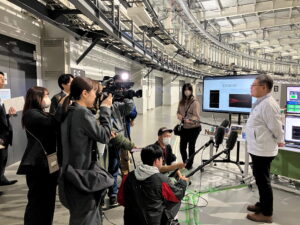
Horiba Beamline Group Leader (QST)
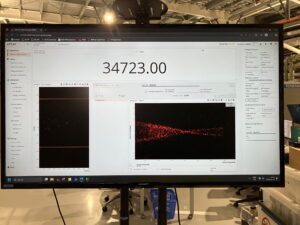
First synchrotron radiation experiment at 400mA
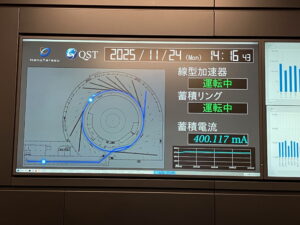
Full-scale operation begins at 400mA
Dr. Masayuki Hagiwara, Group Leader at QST NanoTerasu Center, Receives the FY2025 Award for Distinguished Contributions to Radiation Safety Management and Environmental Radioactivity Control
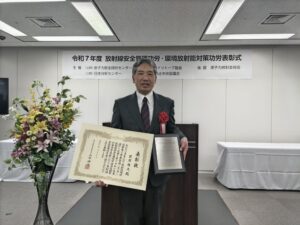
Dr. Masayuki Hagiwara, Group Leader of the Fundamental Technology Group, Department of Advanced Synchrotron Radiation Research and Development, QST NanoTerasu Center, has received the FY2025 Award for Distinguished Contributions to Radiation Safety Management and Environmental Radioactivity Control.
This award is jointly organized by the Nuclear Safety Technology Center, the Japan Radioisotope Association, the Japan Chemical Analysis Center, and the Central Council on Radiation Protection, and is sponsored by the Nuclear Regulation Authority.
It recognizes individuals who have made outstanding achievements in improving the management of radioactive materials or in enhancing measures for environmental radioactivity control.
Dr. Hagiwara was highly commended for his significant contribution to realizing the non-controlled area designation of the experimental hall at the 3 GeV Advanced Synchrotron Radiation Facility (NanoTerasu).
The award ceremony was held on November 10, where Dr. Hagiwara received the Chairman’s Award of the Nuclear Regulation Authority (a certificate of commendation and a commemorative plaque).
Professor Takahashi at Tohoku University has developed a broadband X-ray compatible ptychography system by leveraging NanoTerasu
Professor Takahashi and his team at Tohoku University have successfully developed a high-resolution X-ray ptychography system covering a broad energy range from tender to hard X-rays by leveraging the NanoTerasu Coalition Beamline BL10U.
Development of a Broadband X-ray Compatible Ptychography System
— Achieving high-precision elemental and structural analysis through NanoTerasu utilization.
[Tohoku University Press Release (Website): Development of a Broadband X-ray Compatible Ptychography System]
Professor Takahashi at Tohoku University have utilized NanoTerasu to achieve non-destructive three-dimensional visualization of the interior of CMOS image sensors containing light elements
Professor Takahashi and his team at Tohoku University have successfully utilized the NanoTerasu Coalition Beamline BL10U to non-destructively observe and quantitatively evaluate the three-dimensional structure inside CMOS image sensors at a resolution of approximately 30 nanometers (nm, where 1 nm equals one-billionth of a meter
Non-destructive 3D Visualization of CMOS Image Sensor Interiors Containing Light Elements
— A new frontier in nano-structure analysis enabled by NanoTerasu’s high-brilliance tender X-rays.
[Tohoku University Press Release (Website): Non-destructive 3D Visualization of CMOS Image Sensor Interiors Containing Light Elements]
NanoTerasu Achieves Early Success in Stable Operation at 400 mA Stored Current ~ Doubling Synchrotron Radiation Intensity to Accelerate Advanced Research ~
The research group led by Senior Technical Officer Kota Ueshima and Director Nobuyuki Nishimori of the Accelerator Group at the QST NanoTerasu Center has successfully achieved the early realization of stable operation at a stored current of 400 mA at NanoTerasu. This is a groundbreaking achievement that doubles the synchrotron radiation intensity compared with previous operation.
As a result, the soft X-ray synchrotron radiation supplied by NanoTerasu not only has 100 times the brightness of existing domestic facilities, but also doubles the intensity (photons per second) compared with FY2024. Consequently, the number of samples that can be analyzed using the world’s highest-performance analytical instruments will also double, greatly accelerating research and development in areas such as next-generation device development, innovative materials research, and new discoveries in the life sciences.
QST Press Release
https://www.qst.go.jp/site/press/20250905.html
Related News Articles
Press Conference by Minister of Education, Culture, Sports, Science and Technology Abe Toshiko (September 5, 2025: MEXT Website)
https://www.mext.go.jp/b_menu/daijin/detail/mext_00617.html
Expected to Accelerate research (Nikkan Kogyo Shimbun)
https://www.nikkan.co.jp/articles/view/00760518
NanoTeras Achieves Target Performance Ahead of Schedule, Accelerating Research (Daily Tohoku)
https://www.daily-tohoku.news/archives/350119
NanoTerasu Doubles Synchrotron Radiation Intensity, Expected to Accelerate Research (Yomiuri Shimbun)
https://www.yomiuri.co.jp/local/miyagi/news/20250922-OYTNT50320/
Next-generation Synchrotron Radiation Facility Achieves Target Performance, Ahead of Schedule (Mainichi Shimbun)
https://mainichi.jp/articles/20250915/ddm/016/040/039000c
NanoTerasu Doubles Synchrotron Radiation Intensity — Expected to Improve Experimental Efficiency (Kahoku Shimpo)
https://kahoku.news/articles/20250905khn000064.html
Sendai’s Next-Generation Synchrotron Facility “NanoTerasu” Achieves Target Performance Ahead of Schedule — A Giant Microscope to Accelerate Research (Sankei Shimbun)
https://www.sankei.com/article/20250905-TFVZARBX75K4PBHYUDUU3J2ULE/
NanoTerasu Reaches Double Brightness — Enabling High-Resolution Analysis (Denki Shimbun)
https://www.denkishimbun.com/archives/393353
NanoTerasu Introduces New Equipment — Doubled Synchrotron Radiation Intensity Expected to Accelerate Research [Sendai City] (Sendai Broadcasting)
https://nc.ox-tv.co.jp/news/detail/2025090500016
NanoTerasu Halves the Time Needed for Analysis Using Synchrotron Radiation [Sendai City] (Miyagi TV)
https://news.ntv.co.jp/n/mmt/category/economy/mmdf64f8559a4949d7ae1f38f7178b587a
Research Using NanoTerasu Public Beamline Featured on NHK NEWS
A research achievement using one of NanoTerasu’s public beamlines was featured on NHK NEWS on the morning of June 19.
The study was conducted by Associate Professor Yohei Suzuki and his research team at the University of Tokyo’s Faculty of Science. They analyzed a sample of peridotite collected from approximately 1,200 meters underground—deep enough to minimize the possibility of microbial intrusion from the surface. Using NanoTerasu’s Soft X-ray Nano-Absorption Spectroscopy Beamline, one of its three public beamlines, the team detected elemental signals characteristic of living microorganisms.
This finding suggests the possibility that microorganisms obtained from 2-billion-year-old rock formations may have survived by “breathing” iron oxide.
“Microorganisms from 2-Billion-Year-Old Rock May Have Used Iron Oxide for Respiration – University of Tokyo and Others”
Link to article (in Japanese)
An academic paper concered with NanoTerasu was published by Dr. Liu and Dr. Yabu at Tohoku University
In this study, the world’s highest conversion efficiency level of carbon monoxide (CO) from carbon dioxide (CO2) was achieved using cobalt phthalocyanine (CoPc).
The NanoTerasu public beamline achieves the world’s highest energy resolution
Principal researcher Jun Miyawaki and his colleague at the NanoTerasu Center have developed equipment for resonant inelastic X-ray scattering (RIXS) experiments at the public beamline BL02U of the NanoTerasu. They achieved a world-leading performance with an energy resolution of 16.1 meV, significantly surpassing the previous record of 22 meV. This breakthrough also improved the efficiency of the measurements.
(Press release dated September 18th)
Holding a research meeting of the Laser Society at NanoTerasu
The 589th research meeting of the Laser Society, titled “Next-Generation Laser Processing,” was held on September 9, 2024, in the NanoTerasu Exhibition Hall. This was the first time the research meeting was held in the NanoTerasu Exhibition Hall. With approximately 30 participants, five research presentations were delivered, followed by a tour of the experimental hall.
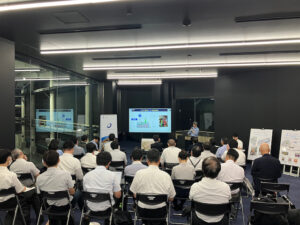
Presentation by Principal Researcher Dinh from QST Kansai Group
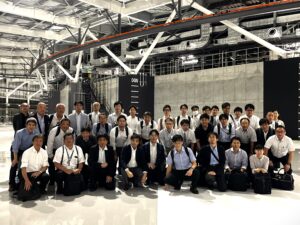
Photo of Participants at the NanoTerasu Experimental Hall
At the international conference SRI 2024, Group Leader Nishimori and Principal Researcher Miyawaki, among others, gave presentations
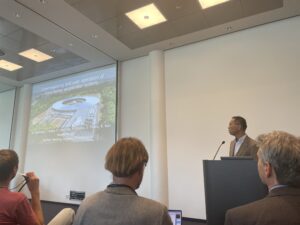
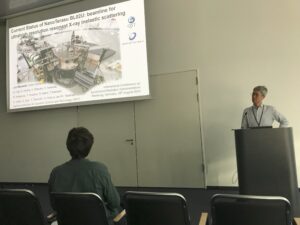
At the ’15th International Conference on Synchrotron Radiation Instrumentation (SRI 2024)’, held in Hamburg, Germany, from August 26 to August 30, 2024, Group Leader Nishimori of the NanoTerasu Center’s Accelerator Group and Principal Researcher Miyawaki of the Beamline Group, among others, gave presentations.